Welcome!
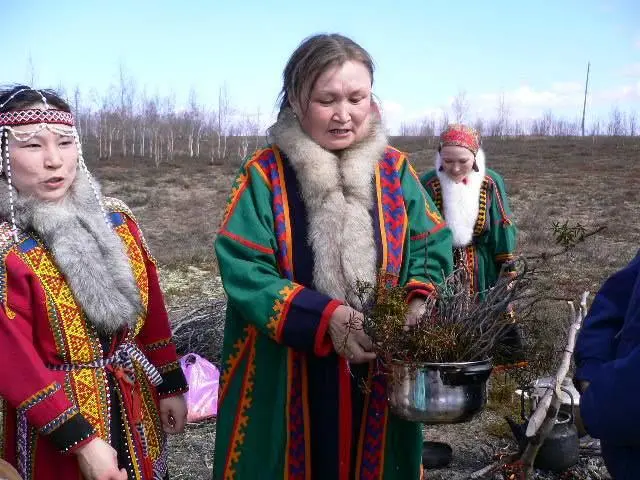
This website is about the Nenets people. Here you will find information about their trades and crafts, and get acquainted with their everyday life and culture.
The Nenets are inhabitants of the North! Since ancient times, they have lived and migrated along the shores of the Kara Sea.
They live in three northern regions of Russia: the Yamalo-Nenets Autonomous Okrug (capital: Salekhard), the Dolgano-Nenets Okrug (capital: Dudinka), and the Nenets Autonomous Okrug (capital: Naryan-Mar).
The Nenets are divided into two groups: the Tundra Nenets and the Forest Nenets. The Tundra Nenets predominantly settle in the Yamalsky, Tazovsky, Priuralsky, and Nadymsky districts. They speak the Tundra dialect of the Nenets language. The second group consists of the Forest Nenets, who inhabit the taiga forest zone.
The most of the Nenets are living in tundra and are called as «man of tundra». Sometimes they call themselves «khasava» (man) or «vy’ khasava» (tundra man), while the Forest Nenets call themselves as «neshang».
History of Origin
Regarding the ethnogenesis—the origin of the Nenets—a number of hypotheses exist. Some scientists consider them descendants of the ancient indigenous population of the tundra, while others believe they came from more southern regions. The fact is that in the 19th century, peoples were discovered in the region of Southern Siberia (the Koibals, Mators, and Kamasins) who spoke languages very close to those spoken by the Nenets, Nganasans, Selkups, and Enets who had already settled in the North.
Today, the most widely accepted assumption is that the Northern Samoyeds formed as a result of a blending between the ancient indigenous peoples of the Arctic and groups of Samoyeds who began moving North in the first centuries AD, eventually reaching the forest-tundra and tundra zones at the turn of the 1st and 2nd millennia AD. From Southern Siberia, the Samoyeds brought their language, reindeer herding, and related cultural traits. It is worth noting that in the Nenets language, many terms related to the Arctic zone are descriptive (the northern seas — «Itya’ Ӈabtenya» — «smelly water»; polar bear — «ser’’ vark», that «ser’’» means white and «vark» means bear; walrus — «tivtey» — the tusked one).
However, further research aimed at uncovering the secret of human appearance in the Far North continues (through archaeological excavations, folklore studies, etc.). In particular, it is believed that the legends current among the Nenets about the «Sikhirtya» people, who hide inside the hills, preserve the memory of the most ancient inhabitants of the Arctic.
Worldview and Religion
According to Nenets beliefs, every object or phenomenon of the surrounding nature—be it a river or a lake, a tree or a stone, a bird or a beast, etc.—has its own «master», which is an independent entity. This perception is one of the manifestations of the ideology of shamanism, which is rooted in animistic concepts linked to the deification of nature and the reverence of the animal world.
The Nenets have a very large and complex pantheon that includes dozens of names: «Ilebyamʼ pertya» – the god who grants people reindeer and life; «Yaʼ Minya» – the patron goddess of birth and the earth; «Khada, Yaʼ malʼ Ne» – the goddess of Yamal; «Yavʼ malʼ khekhe» – the Master (God) of the Ob River, and others. These gods are, in essence, the personification of the forces of nature and act as patrons of various types of human activity.
Two divine figures occupy the most important place in the pantheon. One of them is «Numʼ». This is the supreme deity who resides in the celestial zone of the Universe and governs the destinies of peoples. The second figure is connected to the underworld, where, according to Nenets beliefs, spirits hostile to humans live. «Ӈа» is the head of the spirits of the lower world.
Daily Life, Economy, and Activities
The traditional dwelling of the Nenets is the «mya”». It is a cone-shaped tent consisting of wooden poles, which are covered in winter with covers made of reindeer hides, and in summer with covers sewn from canvas or made from aged winter covers.
Reindeer harnessed to sleds serve as the means of transport in both winter and summer. The Nenets typically use a "fan-shaped" hitching style, meaning the reindeer are positioned side-by-side (ranging from 2 to 6 or 7 animals). The sleds vary depending on their purpose (passenger sleds or freight sleds).
The primary occupations of the Nenets are reindeer herding, hunting (mainly in winter), and fishing (in summer). Tundra dwellers grow up among reindeer and learn to understand them from childhood; therefore, it is no accident that they call themselves «ty’ nyu"»– the child of the reindeer. Indeed, the life of a Nenets person is inseparable from the reindeer. Having domesticated the reindeer, they adapted it to perform transport work by engineering sleds of various designs and specific rigging. Thanks to the use of the reindeer as a transport animal, the Nenets were able not only to penetrate the endless expanses of the North but also to settle them.
Scientists recognize the management technology of Nenets ethnic reindeer herding as the most perfect in the North. The Nenets culture derived from it, having passed through the crucible of historical trials and reforms, has preserved its traditional character almost entirely without losses. [3]
The Development of Nenets Reindeer Herding
The reindeer is the foundation of life for a Nenets family. As the saying goes: «It is not man who leads the reindeer, but the reindeer that leads man across the endless expanses of the tundra». During the course of migration, the tundra nomads cross vast spaces, from sparse woodlands to the Arctic coast. Over centuries, they have established deep-seated rules for managing a reindeer herd («Ty ser"», «Ty perobtsokhona», «Ty manzayakhana»). [4]
In the conditions of northern off-road terrain, reindeer remain irreplaceable transport animals despite the development of aviation, water transport, and ground machinery like tractors, all-terrain vehicles, and snowmobiles. Reindeer are well-adapted for year-round work in the conditions of the tundra and forest-tundra. They possess high cross-country capability, significant load capacity, and substantial endurance.
Bibliography / References Used:
[1] Khomich L.V. The Nenets*. – St. Petersburg: Russky dvor, 1995. – pp. 22-23
[2] Khomich L. V. Collection of Early Articles. Compiled by Vanuyto V. Yu. - Salekhard: GUP YaNAO «Krasny Sever» Publishing House, 2008. – 224p.
[3] Mukhachev A.D., Kharyuchi G.P., Yuzhakov A.A. Nomading Through the Centuries: Reindeer Herding Culture and Ethnoecology of the Tundra Nenets. – Salekhard-Ekaterinburg. 2010. pp. 5-12
[4] Nyaruy V.N., Serpivo V.M. The Nenets: Lessons of the Ancestors. – St. Petersburg: OOO «MIRALL», 2005. p. 40